Facebook Ads Strategy for Shopify Brands: The $45 a Day Test
Every Shopify store that comes to me with a Meta account has the same history. A campaign launched, it did not work, the budget was moved around for three weeks, nothing was learned. The fix is not a better campaign. It is a test structure that produces a readable answer in five days.
This is the one I use. It is how a beauty brand did $60,000 during a stretch where Meta’s delivery was unstable for everyone, and it is the same structure I start from today.
The structure
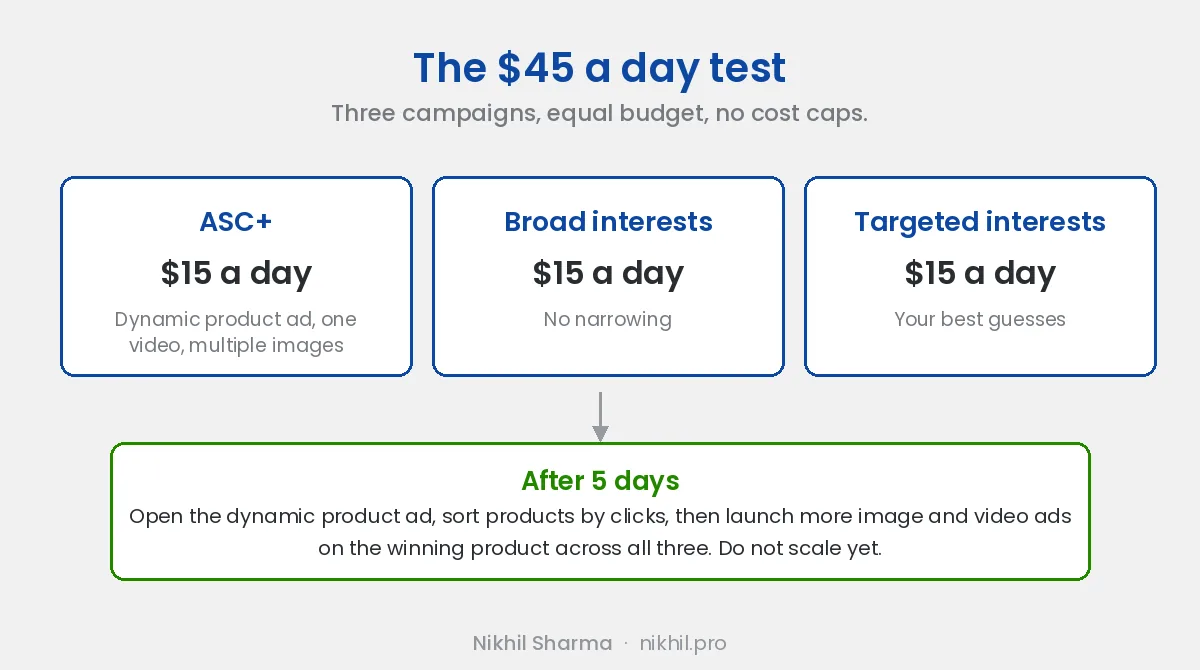
Three campaigns, $15 a day each, ad set budgets rather than campaign budgets:
- Advantage+ Shopping campaign. One dynamic product ad from the catalogue, one video ad, one ad with multiple images.
- Broad interests. No targeting beyond country and age. Same creative.
- Targeted interests. One or two interest stacks that match the product. Same creative.
No cost caps. No bid caps. No daily edits. Let it run for five days.
The point of three campaigns at the same budget is that each answers a different question. ASC tells you whether Meta can find buyers with no help. Broad tells you whether the product sells without targeting. Targeted tells you whether a specific audience is worth paying more for. If you run one campaign, you get one answer and no comparison.
Why $45 and why five days
The number is not magic. It is the smallest spend that produces enough purchases, clicks and add to carts in five days to sort by. On a store with a $40 to $80 product, $225 over five days gets you a few hundred clicks, a few dozen add to carts and somewhere between a handful and a dozen purchases, which is enough to see a pattern and not enough to draw a confident conclusion. That is the right amount of confidence for a test.
Five days because anything shorter is still in learning, and anything longer is money spent on a campaign you already know is losing.
Day six: read the catalogue ad
Open the dynamic product ad in each campaign and sort by clicks. You now have a ranked list of what the audience cared about, and you did not have to guess it. On most stores the top product is not the one the founder would have picked.
Take the winner and launch more creative for it in all three campaigns: two or three new images, one new video, same copy. Keep the budgets where they are.
Do not scale yet. Scaling on day six is the mistake that wastes the test. You have one product that got clicks for five days. You do not yet know whether it converts at a price you can afford, and you do not know whether the clicks came from the audience or from a lucky creative.
Week two and three: confirm, then scale
Run the second round for another five to seven days. If the same product wins again and the cost per purchase holds under your ceiling, you have something. Now scale, and scale the campaign that won, not all three. Raise the budget 20 percent every two to three days rather than doubling it, so the ad set stays out of learning.
If a different product wins in round two, the first result was noise. Launch creative for both and run another round. This happens more than people expect and it is why the structure has a confirmation step.
Feeding Advantage+ Shopping
ASC runs on signal. On an account with history, Meta already has it. On a new account, give it some: upload the customer list as a custom audience and set it as existing customers in the campaign settings, so Meta knows who not to count as new. Without this, ASC quietly retargets your own buyers and reports them as acquisitions.
The audience settings moved around in the interface since this was first written. The existing customer list now lives under the ad account’s audience settings rather than inside the campaign. Set it once there and every ASC campaign respects it.
The campaign most Shopify stores skip
If Meta is your only channel, open a Google Ads account the same week. Meta creates demand. People see the product, do not buy, and search for it a day later. A Shopping campaign catches that search for a fraction of what the Meta click cost. Without it, the sale either goes to a competitor’s listing or does not happen, and Meta’s numbers look worse than they are.
Google’s free product listings in Merchant Center cost nothing and get your products into Shopping results before any paid campaign is live. Set that up first.
What this does not cover
The test finds the product and the audience. It does not fix a store that does not convert, a pixel that is not recording purchases, or creative that is the same thing five ways. Check those before spending the $45 a day, because the test can only be as good as the data coming back from the store.
If you want a second opinion on an account mid test, book a call. I would rather look at it on day six than after a month of budget moves.
Frequently asked questions
How much should a Shopify store spend to test Facebook ads?
Why run three campaigns instead of one?
Should I use cost caps or bid caps during the test?
What is ABO and why use it for testing?
What does a dynamic product ad tell me during the test?
When should I scale after the test?
Do I need Google Ads if I am running Facebook ads for a Shopify store?
Get new posts in your inbox
Occasional notes on Shopify, paid ads, and what I learn. No spam.
Thanks. Check your inbox to confirm.

Nikhil Sharma
I run data and operations for a DTC brand on Shopify, consult on Meta and Google Ads, and build AI automations for ecommerce teams. I write about what I build and run.