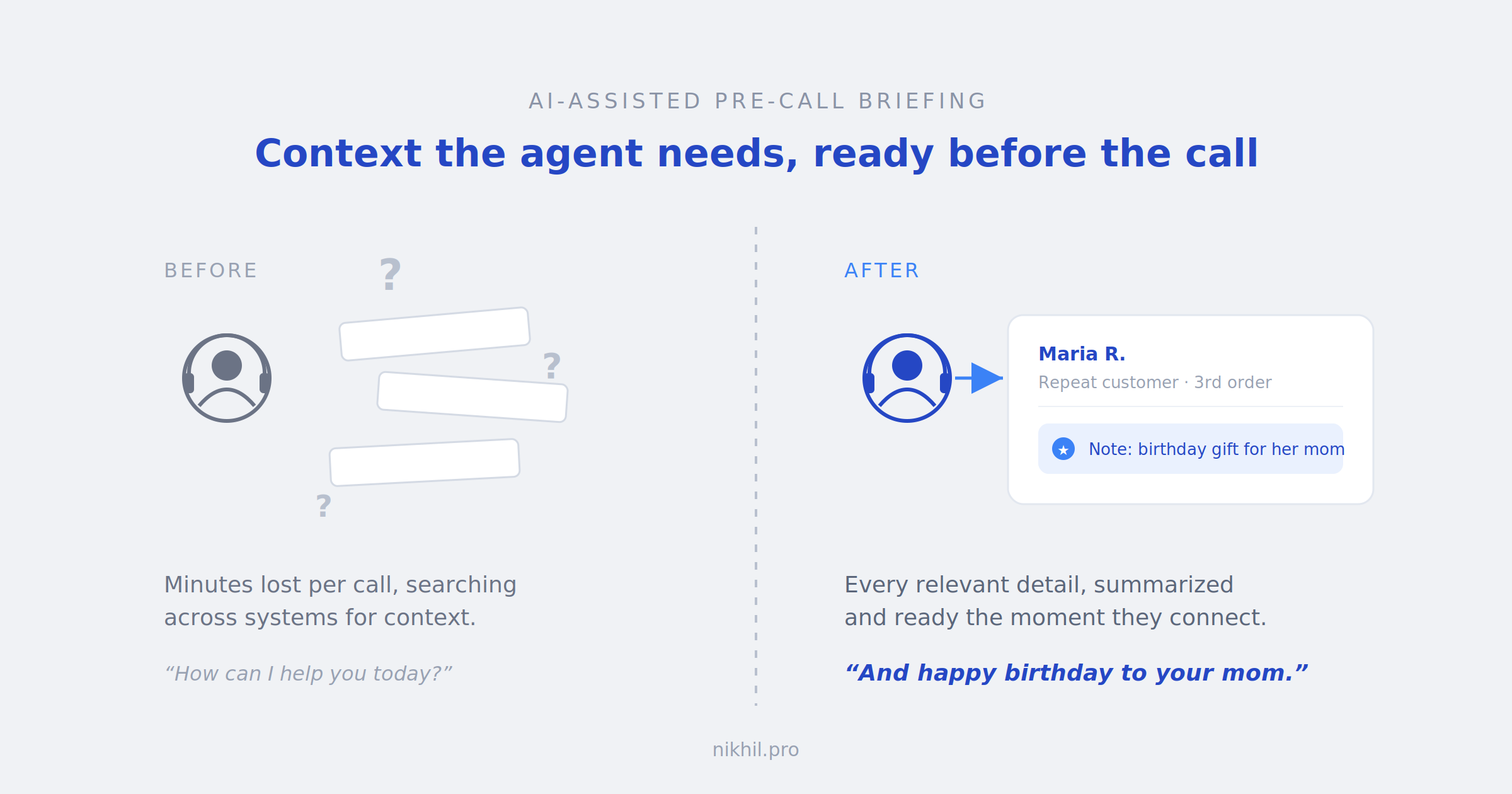
AI Pre-Call Briefing Tool: How I Prep Support Agents Before Every Call
A pre-call briefing tool is an internal AI system that reads a customer’s context, order history, prior tickets, and notes, before a support call and generates a short brief for the agent. It replaces the manual scramble of digging through tabs at the start of every call, so the conversation opens informed instead of fumbling.

I build back-office AI tools for a DTC ecommerce brand. This is a concept-level write-up of one of them: a pre-call briefing tool, sometimes called pre-call intelligence or agent assist. It is one of the highest-leverage and least glamorous pieces of AI I have shipped.
The problem: agents waste minutes scavenging before every call
Before a support agent calls a customer, they spend a few minutes searching across systems to answer basic questions: what did this person order, did something go wrong, have they contacted us before. That prep time, multiplied across every call, is a real cost, and it pushes agents to improvise through the opening of the conversation.
The person making the call is good at talking to people. They should not be spending that time acting as a search engine. Across a day of calls the lost minutes add up, and call quality suffers because the agent is piecing context together live instead of listening.
What I built: an LLM that writes the brief first
The tool runs a language model over each customer’s context before the call and produces a short, structured brief: who they are, what they bought, the likely reason for the call, and anything worth knowing going in. The agent reads it in about five seconds and opens the call already oriented.
I used a fast, inexpensive model tier deliberately. The tool runs on every single call, so a model that is good enough and costs almost nothing per run beats a smarter, pricier one you cannot afford to call constantly. For high-frequency internal AI tools, cost-per-run is often a bigger factor in whether the tool ships than raw model quality.
Why a pre-call briefing tool is worth building
The obvious benefit is time saved per call. The larger benefit is warmth: order notes contain human details, like an order being a birthday gift, that no agent has time to surface live. When the brief surfaces them, the agent can open with genuine, personal context, which turns a transaction into a good customer experience.
A note might say an order is a birthday gift for the customer’s mom. The brief surfaces it, so the agent opens with “and happy birthday to your mom” instead of a flat “how can I help you.” That detail was in the data the whole time. The agent just could not dig it out fast enough on their own.
This is the part most teams underrate. Agent-assist AI is usually pitched as efficiency, but the higher-value outcome is a better conversation, because the context that makes a customer feel known was always sitting in the CRM and order notes, unused.
What actually made it hard: the plumbing, not the model
The language model was the easy part. The hard part was data engineering: pulling context from several different systems, deciding what belongs in a brief versus what is noise, and formatting it so an agent absorbs it in seconds rather than reading a report. The model was a small fraction of the work; integrating it into a real workflow was the rest.
This is the general lesson across the internal AI tools I have built. Getting a model to produce a decent summary is close to trivial now. Getting the right inputs to it, and getting its output in front of the right person at the right moment in a form they can act on, is where the actual engineering lives.
Where it broke, and how I fixed it
The tool would sometimes state a guess as confidently as a fact, for example a wrong assumption about why the customer was calling, in the same tidy tone as the verified details. An agent who over-trusted the brief could walk in mis-oriented. The fix was to visually separate facts from inferences in the brief, so the agent knew which parts were solid and which to confirm.
A confident model is not a careful one. The design had to account for that rather than pretend it away. Keeping the human able to tell verified data from model inference was the difference between a tool agents trusted and one that occasionally embarrassed them.
FAQ
What is a pre-call briefing tool? It is an internal AI tool that reads a customer’s context, order history, prior support tickets, and account notes, before a support call and generates a short brief for the agent. The goal is to replace manual pre-call research so the agent opens the call informed.
What is pre-call intelligence? Pre-call intelligence is another name for the same idea: using automation or an LLM to assemble relevant customer context ahead of a call, so agents do not have to search for it manually while the customer waits.
Which AI model is best for a pre-call briefing tool? For a tool that runs on every call, a fast, low-cost model tier is usually the right choice over a slower, more expensive one. The summarization task is not difficult for modern models, so cost-per-run and latency matter more than raw capability.
What is the hardest part of building an agent-assist AI tool? The integration, not the model. Pulling clean context from multiple systems, filtering out noise, and formatting the output so an agent can absorb it in seconds is ordinary data engineering, and it is where most of the effort goes.
How do you keep an AI briefing tool from misleading agents? Separate verified facts from model inferences in the output. When agents can see which parts of a brief are solid data and which are the model’s guesses, they can trust the reliable parts and confirm the rest in the conversation.
This is a concept-level case study of an internal tool I built. It describes the approach and lessons, not proprietary implementation details. I write about building practical AI tools for ecommerce at nikhil.pro.