ChatGPT Ads for Shopify Brands: Setup, Test and Read, Done With You
OpenAI started selling ads inside ChatGPT answers in 2026. By May any US business could buy them with no minimum, and by June campaigns could bid on a pixel conversion. I set one up for a DTC brand and wrote the full review of what the platform can and cannot do.
This page is the service version: I set the campaign up, run it as a measured test for 30 days alongside your Meta and Google, and tell you whether it earned a place.
Set up and read in 30 days
ChatGPT ads test for your store
Pixel, conversion events, campaign, context hints in your market's languages, exclusions, three to five ads, and a written read against Shopify orders at day 30. Scoped on a call.
Already running Meta or Google with me
Part of the retainer
The test is added to the existing work and reported in the same sheet, against the same Shopify numbers.
Where ChatGPT ads sit
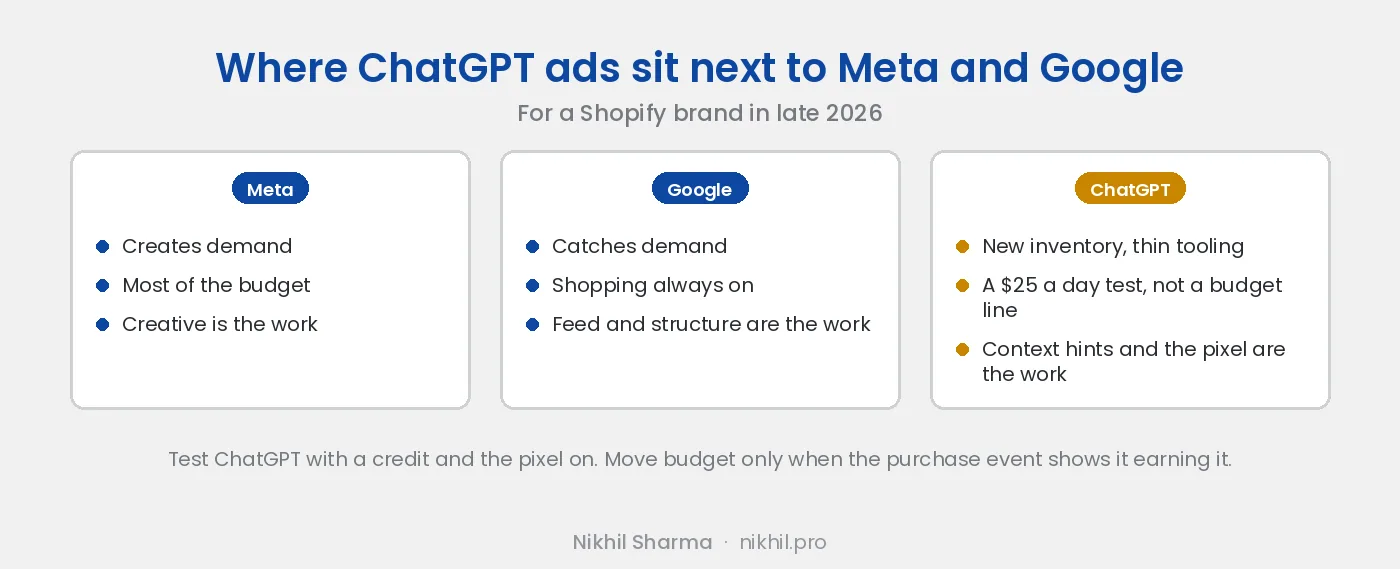
Meta creates demand. Google Shopping catches it. ChatGPT is a third place where people now ask what to buy, and the ads sit inside the answer.
The tooling is thin:
- Targeting is a free text box called context hints.
- Customer lists only exclude.
- Reporting is aggregated; you never see the conversations.
- The campaign is billed by impressions even when it bids on conversions.
Underneath the ads is the protocol layer. OpenAI’s Agentic Commerce Protocol closes purchases inside ChatGPT; Google and Shopify’s Universal Commerce Protocol is the open standard for the same thing, and Shopify publishes a UCP profile for every store at /.well-known/ucp. The setup checks that endpoint, the feed and llms.txt before any ad goes live, because they are what the agent reads after the click. What UCP means for Shopify brands is the longer argument.
What the setup includes
The pixel, first. The browser pixel and the server side Conversions API on the store, with the purchase as the conversion event and a shared event ID so the two do not double count. Conversion campaigns cannot run without this.
The campaign. Conversions objective, bidding on the purchase, Autobid, the daily minimum, locations set, platforms set. The creative enhancement toggle, on by default and able to rewrite and translate your copy without review, decided deliberately: off for any brand with a voice or claims that have to be worded a certain way, on for a bilingual test where the claims survive any wording.
Context hints. The whole targeting model, so most of the thinking goes here. Written as the conversations the ad belongs in, not as demographics, in every language the market speaks. For a bilingual market that means the same intent twice.
Exclusions. The customer list uploaded under Audiences, which the platform allows for exclusion only, so the acquisition ads stop spending on people who already bought.
The ads. Three to five text ads, each with a title inside the 32 character warning and a description inside 54, a square image or a four to six image carousel, and the UTM placeholders for campaign, ad group and ad on every destination URL so GA4 and Shopify can tell them apart from the first click.
The read. At day 30, a written note: orders attributed in Shopify and GA4 against what the platform claims, cost per order, which hints and which ads the orders came from, and a recommendation to stop, hold, or fund.
Who this is for
It is for a Shopify brand in the US, already running Meta or Google profitably, with the tracking in order and a product that answers a question people ask: a gift, a replacement, a what should I get for. Those are the conversations ChatGPT ads sit inside.
It is not for a brand selling on impulse and visuals, which will likelier find Meta still wins, and the read will say so. Nor for a store that has not yet proved its product on Meta or Google, because a test on a thin new channel will not tell you anything the main channels could not tell you faster. And it is not available to businesses outside the US yet.
What it costs
For brands I already run Meta or Google for, the test is added to the retainer and reported in the same sheet. On its own it is a fixed setup fee plus the 30 day read, scoped on a call.
Set up and read in 30 days
ChatGPT ads test for your store
Pixel, conversion events, campaign, context hints in your market's languages, exclusions, three to five ads, and a written read against Shopify orders at day 30. Scoped on a call.
Want to do it yourself first
The review
Every screen of the platform, the limits, the defaults to change, and what a Meta buyer will not find.
The organic side of the same channel, getting your products into ChatGPT’s answers without paying, is in getting listed in ChatGPT shopping and the ChatGPT shopping checklist. The two core channels are on their own pages: Meta ads and Google Ads.