What is Meta Andromeda?
If you’ve been running ads the past few years, you know it’s been chaos. Apple n*ked targeting with iOS14.5, Meta rebuilt its engine, and now we’re in the Andromeda era - where creative isn’t just important, it’s everything.
Let’s break down how we got here, what Andromeda actually is, and how you should be building ads now.
Here’s what Meta says about Andromeda:
According to Meta’s engineering team, “Andromeda is a personalized ads retrieval engine powered by advanced AI and custom hardware like the NVIDIA Grace Hopper Superchip and Meta’s MTIA accelerators. It reimagines the retrieval stage - the part of the system that has to sift through tens of millions of ad candidates in real time - using deep neural networks and a hierarchical indexing system.
Meta says this delivers a +6% recall boost and an +8% ads quality improvement, while also preparing the system to handle the creative explosion from Advantage+ automation and generative AI tools.”
Looks confusing, huh? Here’s the easy version:
Before Andromeda, the system let almost any ad variation slip through, even tiny tweaks like a new background color.
Now, the engine is way pickier. It only surfaces ads that look and feel like genuinely different ideas. That’s why small changes don’t work anymore - if you don’t give Meta enough variety, your ads never even make it out of the “tens of millions” pile into the handful a user will actually see.
The Golden Age: Pre-iOS 14
This was “easy mode.” Meta ads worked like a math equation:
find the right audience + show them an ad = conversions.
- How it worked: Meta leaned on third-party data like the IDFA (Identifier for Advertisers) plus the Pixel to track everything users did.
- The playbook: Stack tiny custom audiences, run lookalikes, and let targeting carry you. Creative mattered, but it wasn’t the star.
Then Apple’s iOS 14 hit. Tracking collapsed. The old playbook died overnight.
If your add to carts and purchases stopped recording properly around then, that was the same event.
The Recovery: Meta Lattice (2023–2024)
Meta’s answer was Meta Lattice, a new AI system trained on billions of data points.
Instead of obsessing over micro-targeting, advertisers leaned on broad audiences + better creatives. Creative testing became the new battleground. Meta also launched a lot of different things like Advantage+ Shopping and the Advantage+ Placements with a whole range of Advantage+ things, just like Google’s Performance Max.
But this was just the warm-up.
The Leap: Meta Andromeda
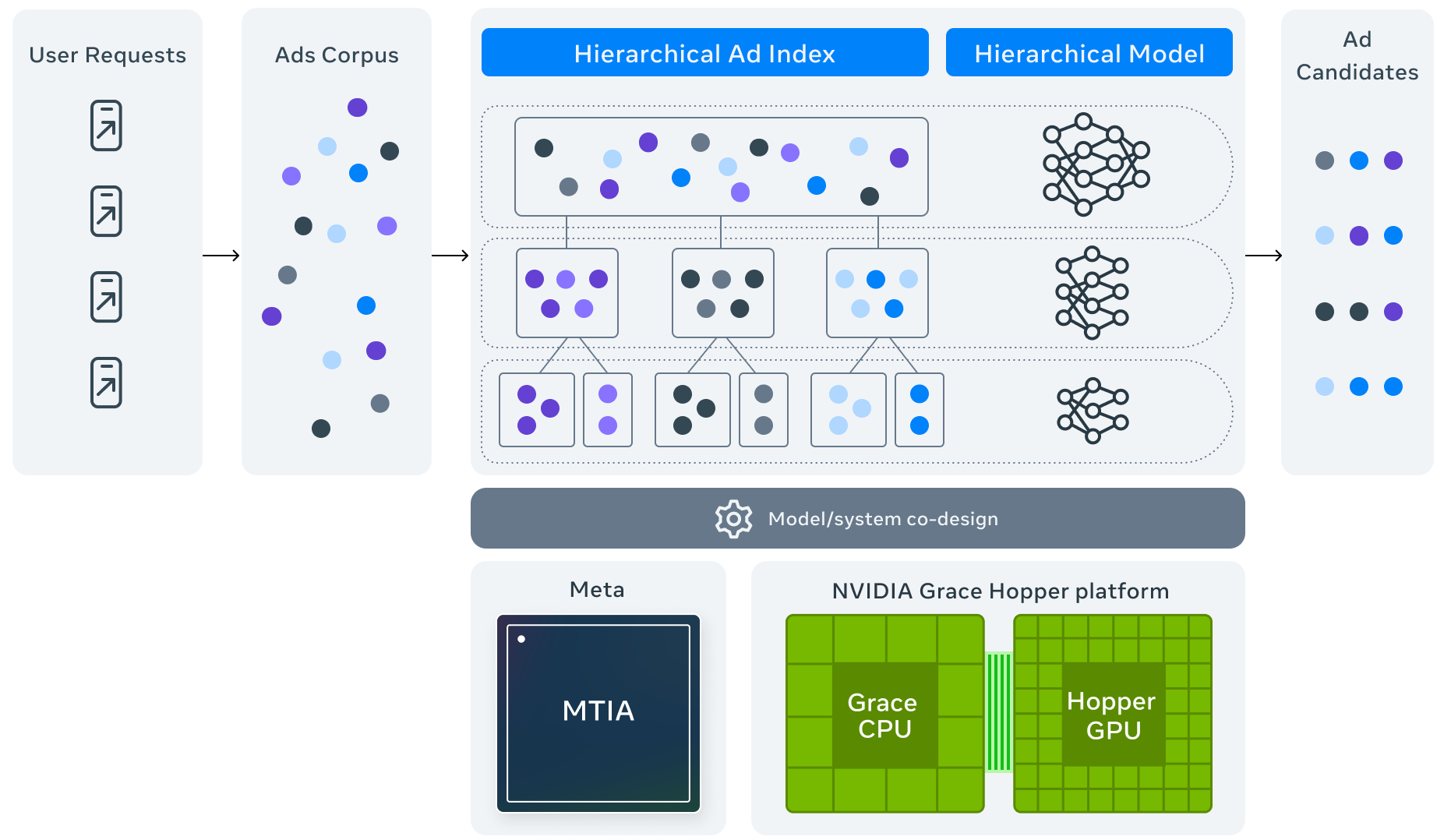
Enter Andromeda, Meta’s next-gen AI architecture.
What makes it different?
- Built on massive model scale
- Trained to predict what creative will work before you even launch it
- Smarter at finding buyers without pixel-perfect tracking
Entity IDs: The Part That Became Concrete
When I first wrote this, “Meta groups similar ads” was something you inferred from delivery behaviour. It is now an observable mechanic with a name.
Meta assigns each creative an internal Entity ID based on its visual fingerprint. It runs computer vision over the visuals, language processing over the copy, and audio analysis over video. If several ads score above a similarity threshold across those dimensions, they collapse into the same Entity ID.
One Entity ID is one entry into the retrieval auction.
So if you upload thirty ads sharing a template, background and structure with different text overlays, Andromeda does not see thirty candidates. It sees one. If that single entry fails for a given user segment, the other twenty-nine never had a chance, because as far as the auction is concerned they were not there.
This is also why copy changes rarely rescue a batch. Different headlines over the same hero image, or a new script over the same footage, typically stay inside one entity. The difference has to register visually, structurally, or in the audio.
Where to check it
Meta now surfaces three creative-level metrics that give you partial visibility.
| Metric | What it tells you |
|---|---|
| Creative Similarity Score | How alike your ads look to Meta. A proxy for Entity ID overlap |
| Creative Fatigue Score | Whether an audience has seen a creative too many times |
| Top Creative Themes | Which thematic buckets your ads fall into, and how budget splits across them |
Practitioner reporting puts the suppression threshold around 60% similarity, with a working target of keeping it under 40%. Those are field-reported figures rather than published Meta thresholds, so treat them as a guide.
Entity IDs themselves are not exposed to advertisers, so the similarity score is the closest read you can get. I’ve written the full breakdown in why Meta only spends on a few of your ads.
What stopped working
Cranking out 3–5 slight variations of the same idea, swapping backgrounds or fonts, and relying on a single designer to recycle static changes doesn’t move the needle anymore.
The harder version of that: most “hook tests” are not tests. If four variants share the same footage and differ only in the opening line, Meta likely grouped them. You ran one ad with four captions and learned nothing about hooks.
What works now (post-Andromeda)
Andromeda rewards volume + variety, in that order of dependency. Variety without volume is slow. Volume without variety is wasted, because it collapses.
- 4–10 unique designs per concept
- Big differences in layout, visual style, and even copy
- Static + video designers collaborating on each idea
- Every ad concept launched as a bundle of variations
This approach consistently improves ad hit rate (the % of ads that become winners).
Quick math: Ad Hit Rate (%) = (# Winning Ads ÷ # Ads Tested) × 100
- 2% = broken process
- 10–20% = healthy, scalable system
What counts as real variation
Vary along these axes, not along copy:
| Axis | Weak variation | Real variation |
|---|---|---|
| Footage | Same clips recut | New shoot, location, talent |
| Format | Same video, new caption | Talking head vs montage vs static vs carousel |
| Opening 2 seconds | New text overlay | Different subject, framing and motion entirely |
| Audio | Same VO, new music | Different voice, pacing, or silence |
| Structure | Reordered beats | Different narrative shape |
| Theme | Same claim, new words | Different reason to buy |
If you are working within a single format, Meta’s flexible ad format gives you another lever for surfacing different assets to different people.
Fatigue Got Faster Too
The second-order effect nobody warns you about.
Where relaunching a campaign or swapping hooks used to reset performance, the current system degrades repeated messaging much faster. Duplicate-and-relaunch does not work the way it used to.
The cadence most teams are landing on is a 50/30/20 split: 50% new concepts, 30% refined variants of what is working, 20% proven performers left running, refreshed every two to three weeks.
If creative is burning out faster than you can replace it, fixing ad fatigue covers that separately.
Action steps to adapt
- Stop iterating. Start variating. Color swaps aren’t strategy. New layouts and angles are.
- Check your Creative Similarity Score first. Before diagnosing creative quality, confirm the system is actually seeing your ads as distinct.
- Add more hands. Even one extra static designer or video editor can double your creative output.
- Think in bundles. Each ad concept = 3–10 versions. Build that into your workflow.
- Track winners, not output. Don’t brag about “making 50 ads.” Brag about your hit rate.
- Do better research. Study 3–5 ads in your niche, then remix them into something original. Beauty and supplement brands are usually ahead of the curve - watch them. I broke down how we scaled a beauty brand across Google, Meta and email if you want a worked example.
- Deploy more UGCs Try getting more user-generated content, you can generate them from ChatGPT Sora, Google VEO or can get it done by influencers.
What I recommend?
Test as many ads as you want - don’t rely on Meta Andromeda. Experiment as much as you can with creatives, but make sure they’re the kind you’d want to buy from yourself: simple, appealing, and effective.
Follow The P.D.A. Framework
To create the required diversity, you should follow the P.D.A. Framework for building conceptually different ads:
-
P is for Persona (The “Who”): Define the specific situation, identity, and pain points of the person you are talking to.
- Example: Instead of “people interested in fitness,” use “The new mom who feels she’s lost her identity” or “The busy male professional worried about his health.”
-
D is for Desire (The “What”): Tap into their core motivation and the transformation they truly want (usually falling into buckets like Wealth, Health, or Relationships/Status).
- Example: “More energy to play with kids” vs. “Feeling confident and attractive for date night.”
-
A is for Awareness Level (The “Where”): Position the ad based on where the persona is on their customer journey (Eugene Schwartz’s concept):
- Unaware: They don’t know they have a problem or that a solution exists.
- Problem Aware: They know they have a problem but don’t know the solution.
- Solution Aware: They know they need a solution (e.g., a workout program) but don’t know why yours is the best.
What should you do?
- Audit your current workflow – are you actually producing variety, or just recycling?
- Pull your Creative Similarity Score and Top Creative Themes before anything else.
- Build a creative system that outputs bundles, not one-offs.
- Track your hit rate weekly. If it’s under 10%, your process is broken.
- Treat creative like product development: research, test, launch, refine.
That’s how you win in the Andromeda era.
If you’re running a Shopify store specifically, the 2026 Meta ads scaling guide covers budget structure and scaling decisions on top of this, and the KPIs that actually matter is worth reading before you judge any of it on platform-reported numbers.
The big takeaway
- Diversity is the mechanic, not the advice. Meta is literally measuring how different your ads are and gating delivery on it. Combine P.D.A. variables to create fundamentally different concepts (e.g., Persona A + Desire Y + Awareness C).
- Ad Concept Volume: The sweet spot for truly different ad concepts is around 8-15 per campaign.
- Budget Rule of Thumb: The Ideal Daily Budget should be at least 3x your target Cost Per Acquisition (CPA) to give the algorithm enough resources to test the creative portfolio properly.
- Check the score. If your Creative Similarity Score is high, no amount of extra output fixes it. You are producing more of the same entity.
Frequently asked questions
What is Meta Andromeda?
How is Andromeda different from Meta Lattice?
Why do small ad variations stop working under Andromeda?
What is Creative Similarity Score and where do I find it?
How many ad concepts should I run per campaign?
Is targeting dead under Andromeda?
What is a good ad hit rate?
How often should I refresh creative under Andromeda?
Get new posts in your inbox
Occasional notes on Shopify, paid ads, and what I learn. No spam.
Thanks — check your inbox to confirm.

Nikhil Sharma
I'm Nikhil Sharma. I write about Shopify, paid ads, email, and the systems I build for the DTC brands I work with.