Hire a Shopify Google Ads Expert: Shopping, Performance Max and Merchant Center
Google Ads for a Shopify store is mostly a Shopping problem, and Shopping is mostly a feed problem. The accounts that come to me spending real money on Google share a pattern: Performance Max running alone, the Merchant Center feed last looked at when it was set up, brand searches counted as wins, and a platform ROAS that Shopify’s own numbers do not recognise.
This page is what I do about it for Shopify brands in the US, Canada and Europe, who it is for, and what it costs. If you want to vet someone else, the hiring guide has the questions to ask. The Meta side of the work has its own page.
Spending over $5,000 a month
Free audit of your Google Ads account
The Merchant Center feed check, the brand search leak, and Google reported conversions against Shopify orders, sent to you whether or not we work together.
Below that, or just want a second opinion
Paid consultation, one hour
Your account open, specific questions answered, no engagement needed.
Where the money usually leaks
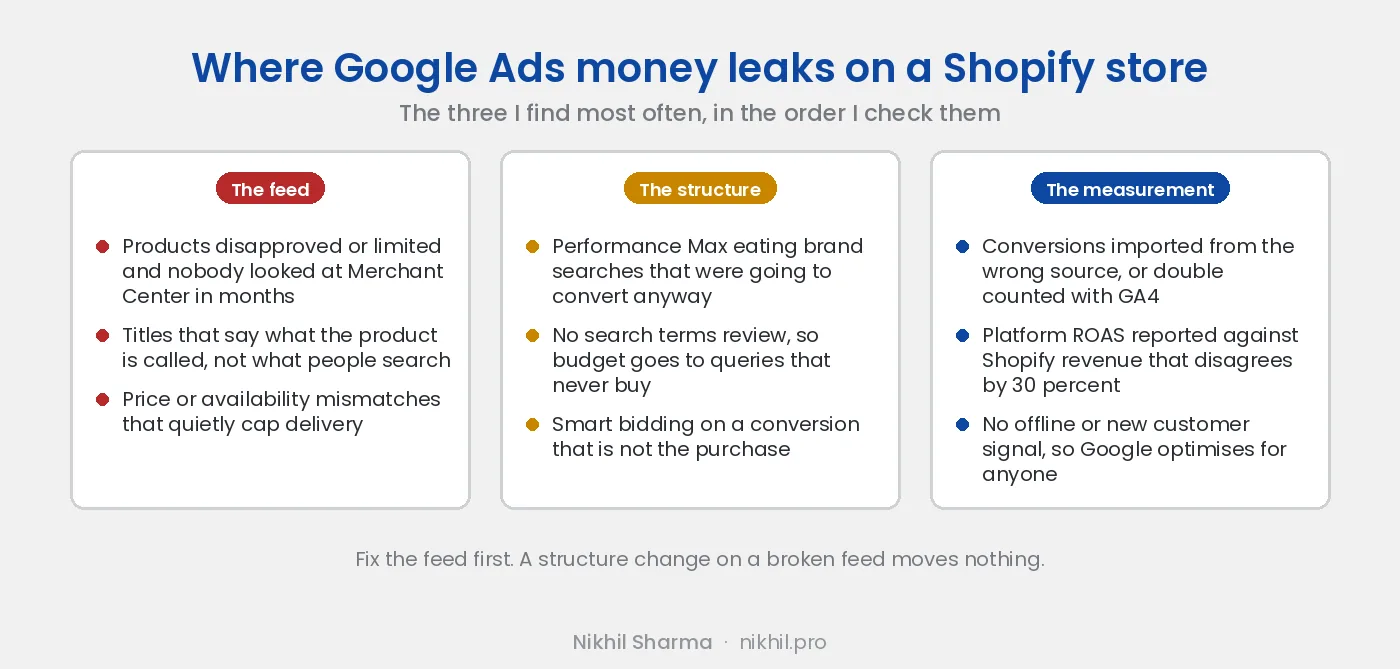
The feed. Merchant Center is the part of Google Ads nobody opens. Products sit disapproved or limited for months, titles say what the product is called internally rather than what a person types, attributes are missing, and the price in the feed drifts from the price on the site.
The structure. Performance Max on its own, with brand not excluded, so it bids on people searching your store name who were about to buy anyway and reports them as conversions. No search terms review. Smart bidding pointed at a conversion that is not the purchase, because that is what the setup wizard chose. The Performance Max guide covers the fixes in detail.
The measurement. Conversions imported from the wrong source, or from GA4 and the Google Ads tag both, so every order counts twice. Platform ROAS that disagrees with Shopify by 30 percent and nobody has reconciled. No new versus returning customer signal, so Google optimises for anyone who buys rather than anyone new. The KPIs post covers what to measure instead.
How I work an account
Audit, first two weeks. Every product’s Merchant Center status. Search terms for the last 90 days against what converted. Google reported conversions against Shopify orders, day by day, with brand and non brand separated. Conversion sources, deduplication, and whether the purchase event Google bids on is the purchase. It ends with a ranked list of what is costing money and the evidence for each.
Feed. Titles rewritten for search: the attributes people type, in the order they type them, with the brand where it helps and not where it does not. Missing attributes filled. Disapprovals cleared, and a weekly check so they stay cleared. Supplemental feeds for the things Shopify’s export does not carry.
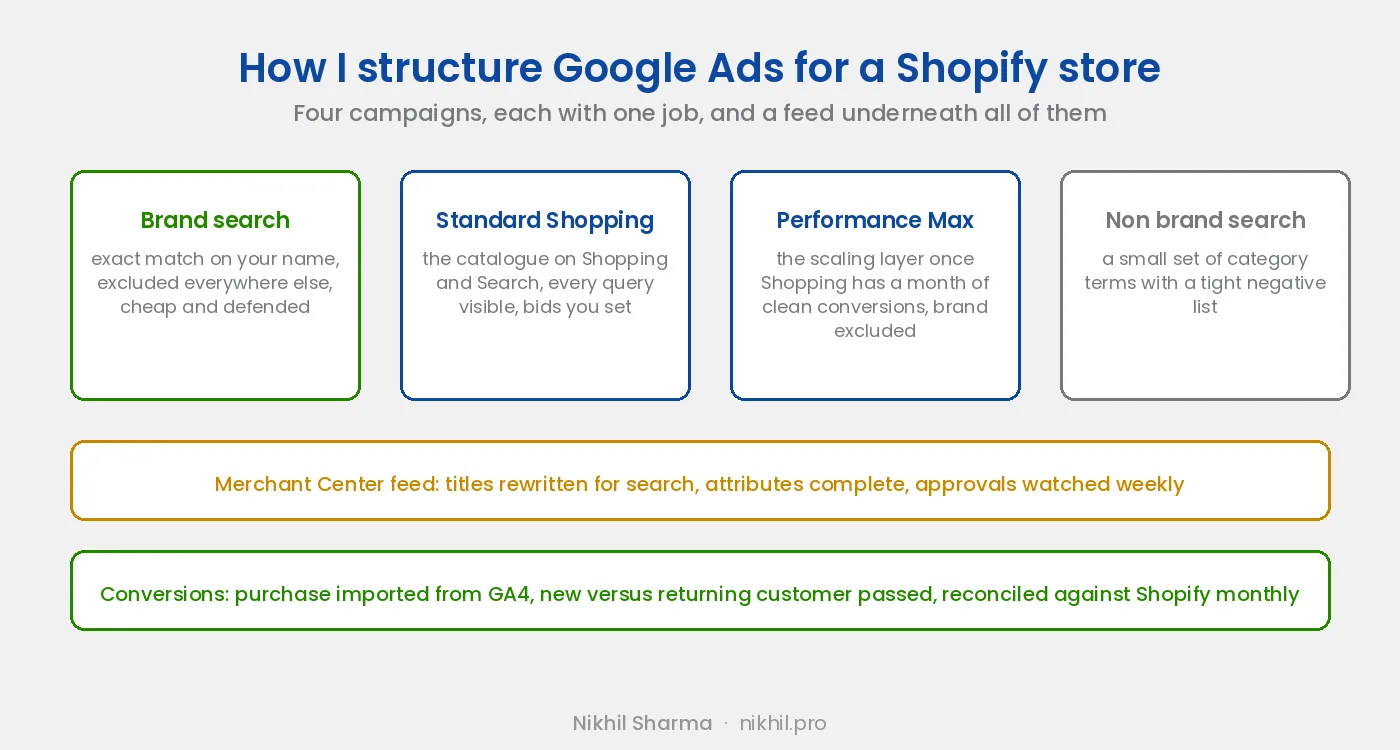
Structure. Four campaigns with one job each:
- Brand search on exact match, excluded everywhere else, because defending the name is cheap and losing it to a competitor is not.
- Standard Shopping for the catalogue, every query visible, bids set by hand until the data says otherwise.
- Performance Max as the scaling layer once Shopping has a month of clean conversions, with brand excluded and asset groups that match the catalogue’s real segments.
- Non brand search, small, for the category terms Shopping cannot reach, with a negative list that grows weekly.
Measurement. The purchase imported from GA4 as the primary conversion, nothing else counted as primary, new versus returning customer passed so Google can be told to find new ones. Enhanced conversions on. Monthly reconciliation against Shopify, by campaign, written down.
Reporting. Contribution margin after ad spend, cost per new customer, brand versus non brand split, and feed health, in a sheet you own. Not a deck, and not platform ROAS as the headline.
Who this is for, and who it is not
It is for a Shopify store with a catalogue people search for, by product name or category, with consistent sales and enough spend that a 20 percent efficiency gain pays the retainer several times over. In practice that starts around $10,000 a month across Google and Meta together. The brands I do my best work with are between $100K and $700K a month in revenue, where the feed and the structure are big enough that fixing them moves the whole business.
It is not for a store with a single new product and no search demand yet. Shopping needs people to be searching for what you sell; if they are not, Meta is where the demand gets created, and the $45 a day test is the place to start. Nor for a store whose feed is fine and whose problem is the product page; that is the CRO audit.
What it costs
A flat monthly retainer scoped in hours and deliverables, not a percentage of ad spend. Google alone is possible when Meta is already handled well, and the price reflects the narrower scope. Either way it is less than an agency at the same spend, and the work is not handed to a junior account manager because there is not one.
The agency or freelancer post is the honest comparison, including the cases where an agency is the right call.
Two ways to start
For stores spending over $5,000 a month in the US, Canada or Europe, the audit is free and you get the findings either way. Below that, or if you want a second opinion without an engagement, the paid hour is the right door.
Spending over $5,000 a month
Free audit of your Google Ads account
The Merchant Center feed check, the brand search leak, and Google reported conversions against Shopify orders, sent to you whether or not we work together.
Below that, or just want a second opinion
Paid consultation, one hour
Your account open, specific questions answered, no engagement needed.
I am Nikhil Sharma. I run data and operations for a DTC brand alongside this work, which is why the feed and the reconciliation get as much attention as the campaigns. The Meta side is on its own page, ChatGPT ads are the third channel I set up as a test, and if the problem is the team’s time rather than the ad account, the automation side is the other half of what I do.