Hire a Shopify Meta Ads Expert for US and European Brands
If you run a Shopify store in the US, Canada or Europe and spend real money on Meta, you have felt the last three years: CPMs that doubled, creative that fatigues in weeks instead of months, and a platform that reports a ROAS your bank account does not recognise. Meta ads are not broken. The set-and-forget version of them is.
This page is what I do about it, who it is for, and what it costs. If you want to vet someone else, the hiring guide has the questions to ask.
Where the money usually leaks
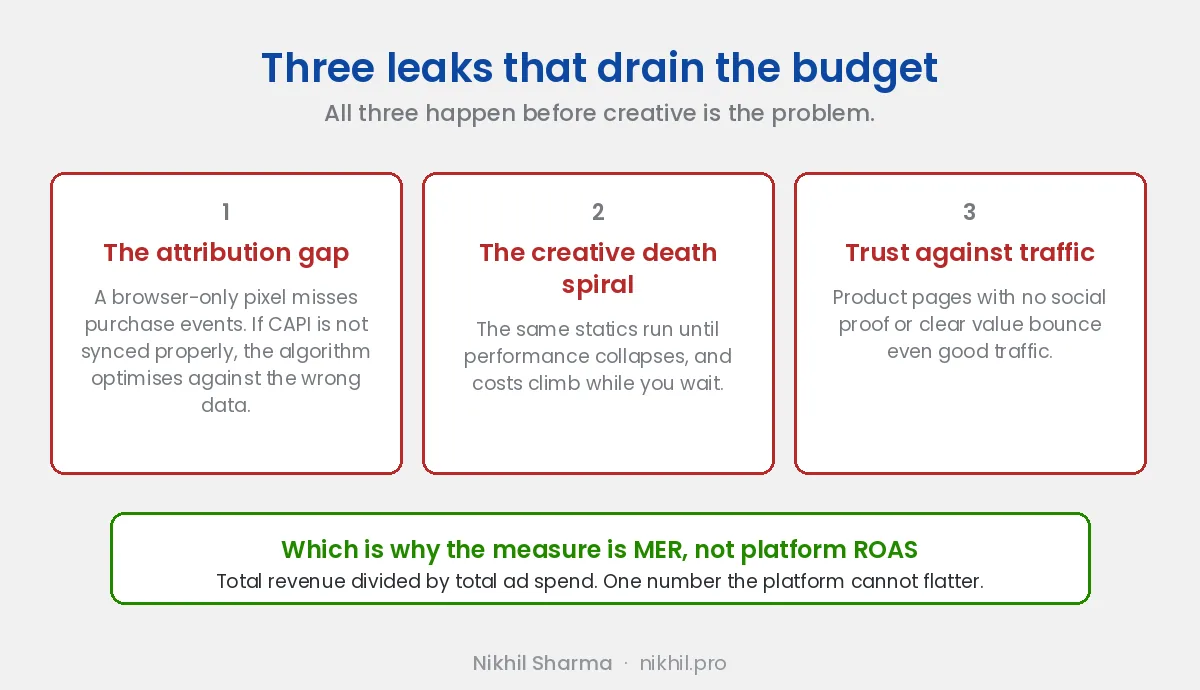
Almost every account I open has one of three problems, and usually the first.
Tracking. The pixel is installed twice, or the Conversions API was never connected, or the events are not deduplicated. Meta optimises on what it can see, and when it sees half the purchases it finds the wrong customers. The symptoms look like a creative problem. The diagnostic takes twenty minutes.
Creative that is one idea in twenty files. Since Andromeda, Meta groups near identical ads and spends on one of them. Brands upload thirty variations, see spend on three, and conclude Meta is broken. The fix is fewer concepts that are actually different, on a refresh cadence that matches how fast they tire now.
A store that does not hold the traffic. No reviews on the product page, a shipping cost that appears at checkout, a mobile load time nobody measured. Meta amplifies whatever the store is. If it does not convert, better ads make it fail faster. Trust vs traffic covers this, and the CRO audit is the structured version.
How I work an account
Audit, first two weeks. Shopify orders against Meta and Google reported purchases, day by day. Pixel, CAPI, deduplication, event match quality. Merchant Center feed health. Email authentication. The audit ends with a ranked list of what is costing money and the evidence for each item. Everything after is in that order.
Structure. A small number of campaigns. Advantage+ Shopping fed with a clean existing customer list so it stops counting your own buyers as acquisitions. Google Shopping always on underneath, because it catches the people Meta made curious. The full structure is in the scaling post, and I publish it because the structure is not the hard part.
Creative. The hard part. A testing system that produces distinct concepts weekly, a mix of shot footage and AI assisted production for the things you cannot shoot, and a kill rule so losers stop spending on day five rather than day thirty.
Reporting. Marketing efficiency ratio, contribution margin after ad spend, cost per new customer, and returning customer rate. The KPIs post explains why those and not platform ROAS. You get the sheet, not a deck.
Results on accounts like yours
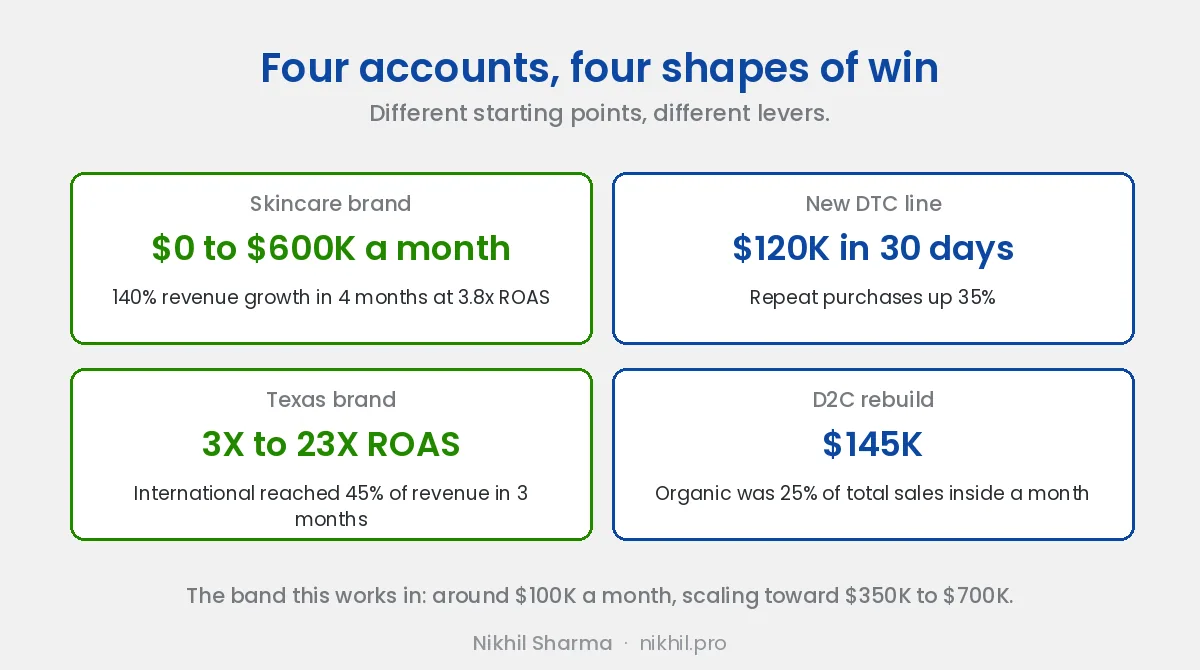
A skincare brand taken from Etsy to Shopify to $50,000, then scaled through Canada and Europe with Google Shopping, Meta and Klaviyo. The same brand’s $700K Q4 on a channel split where Google and Meta opened cold and Snap and TikTok closed warm. A Texas brand from 3X to 23X ROAS by fixing tracking before touching creative. A D2C rebuild to $145K where a quarter of revenue ended up organic because the store was restructured for AI search at the same time. Across all of them I have managed around $5M a month in combined Google and Meta spend.
Every one of those is written up with the numbers at each stage, including the parts that did not work.
Who this is for, and who it is not
It is for a store with consistent sales, a product people reorder, and enough ad spend that a 20 percent efficiency gain pays the retainer several times over. In practice that starts around $10,000 a month in spend. The brands I do my best work with are between $100K and $700K a month in revenue and want the next step without the margin going with it.
It is not for a store still testing products. At that stage the job is finding what sells, cheaply, and a retainer is a fixed cost on a store that has not yet proved its economics. Run the $45 a day test yourself, read the checklist, and come back when the product is chosen. I would rather tell you that now than invoice you for three months of it.
What it costs
A flat monthly retainer scoped in hours and deliverables, not a percentage of ad spend. Percentage of spend is the agency norm and it quietly rewards spending more rather than earning more. The exact figure depends on channels in scope and spend; it is less than an agency at the same spend and the work is not handed to a junior account manager, because there is not one. I take a small number of accounts so that each gets hours a week, not minutes.
The agency or freelancer post is the honest comparison, including the cases where an agency is the right call.
Two ways to start
Free audit. For stores spending over $5,000 a month in the US, Canada or Europe, I will do the Shopify versus platform purchase comparison and the tracking check and send you what I find, whether or not we work together. Book the audit call.
Paid consultation. One hour, your account open, specific questions answered. For stores below the audit threshold or owners who want a second opinion without an engagement. Book a consultation.
I am Nikhil Sharma. I run data and operations for a DTC brand alongside this work, which is why the tracking and the reporting get as much attention as the creative. If the problem is the team’s time rather than the ad account, the automation side is the other half of what I do. More on the about page.