How to Migrate From Etsy to Shopify (and Keep Etsy Open)
Etsy sellers ask me this question most often right after Etsy changes a rule on them. In March 2024 it was the processing schedule email. Before that it was Offsite Ads. It will be something else next year. The answer has not changed, and the second half of this post is the part most guides skip: how to actually do the move.
The decision in one paragraph
Add Shopify. Do not leave Etsy. Etsy brings buyers to you, which is worth a great deal and is the thing you cannot replace on day one. Shopify gives you the customer list, the checkout, your own fees and nobody emailing to say a setting has been changed on your behalf. Run both, with Shopify as the store you own and Etsy as the channel that feeds it. Leave Etsy only when the Shopify store earns more than Etsy search sends, and for most sellers that takes about a year.
What you gain and what you take on
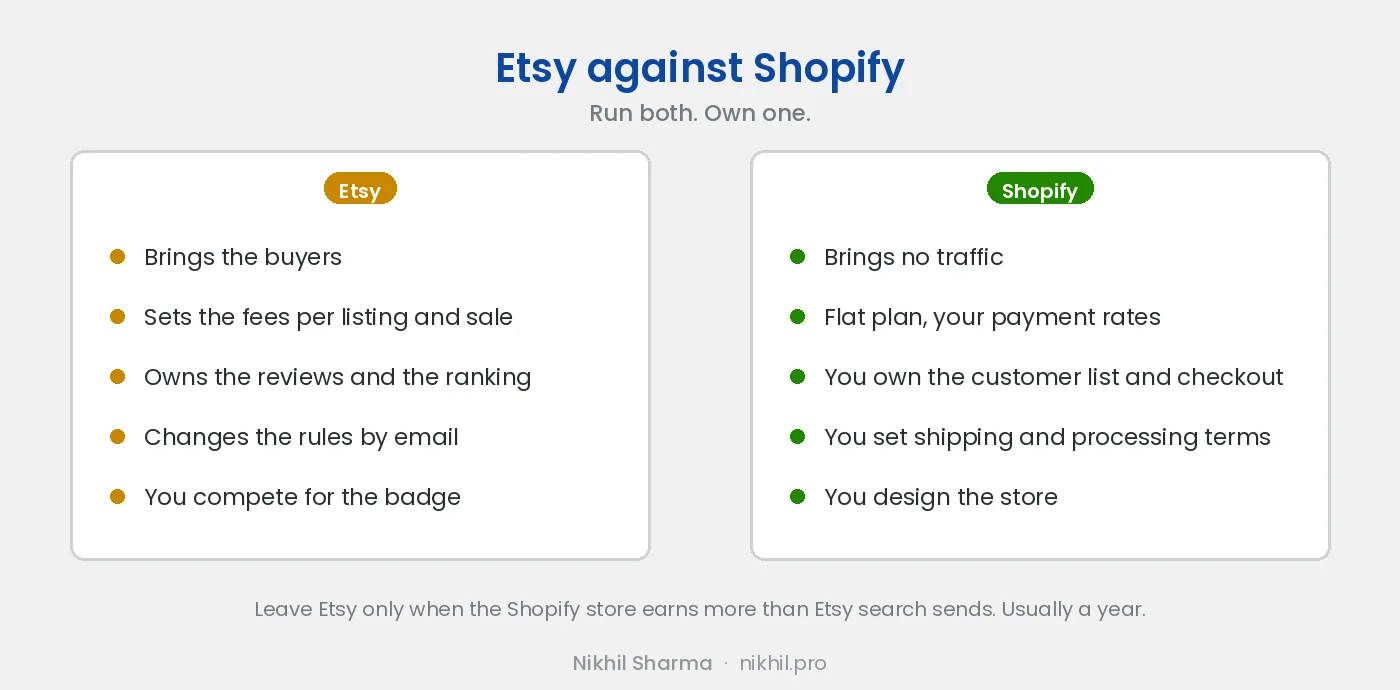
On Shopify you own the customer list, set your own shipping and processing terms, pay a flat plan instead of a per sale listing and transaction stack, and stop competing for a star seller badge. You also design the store, which on Etsy you cannot.
In exchange you bring every visitor yourself, you handle payments and disputes, and you are responsible for whether the store converts. Etsy did all three. That is the trade, and it is a good one for a seller who intends to grow, and a bad one for a seller who wants to make things and let the marketplace handle the rest.
How to migrate, step by step
1. Export the listings from Etsy
Shop Manager, then Settings, then Options, then the Download Data tab. Under Currently for Sale Listings, click Download CSV. The file is EtsyListingsDownload.csv.


Download your order history and your reviews from the same page while you are there. You will not import them, but you will want them.
2. Understand what the file does and does not carry
The Etsy export has title, description, price, currency, quantity, tags, materials, up to ten image URLs, the SKU, and the variations. Shopify’s product import wants different column names, a handle for each product, one row per variant, and options named in its own way.
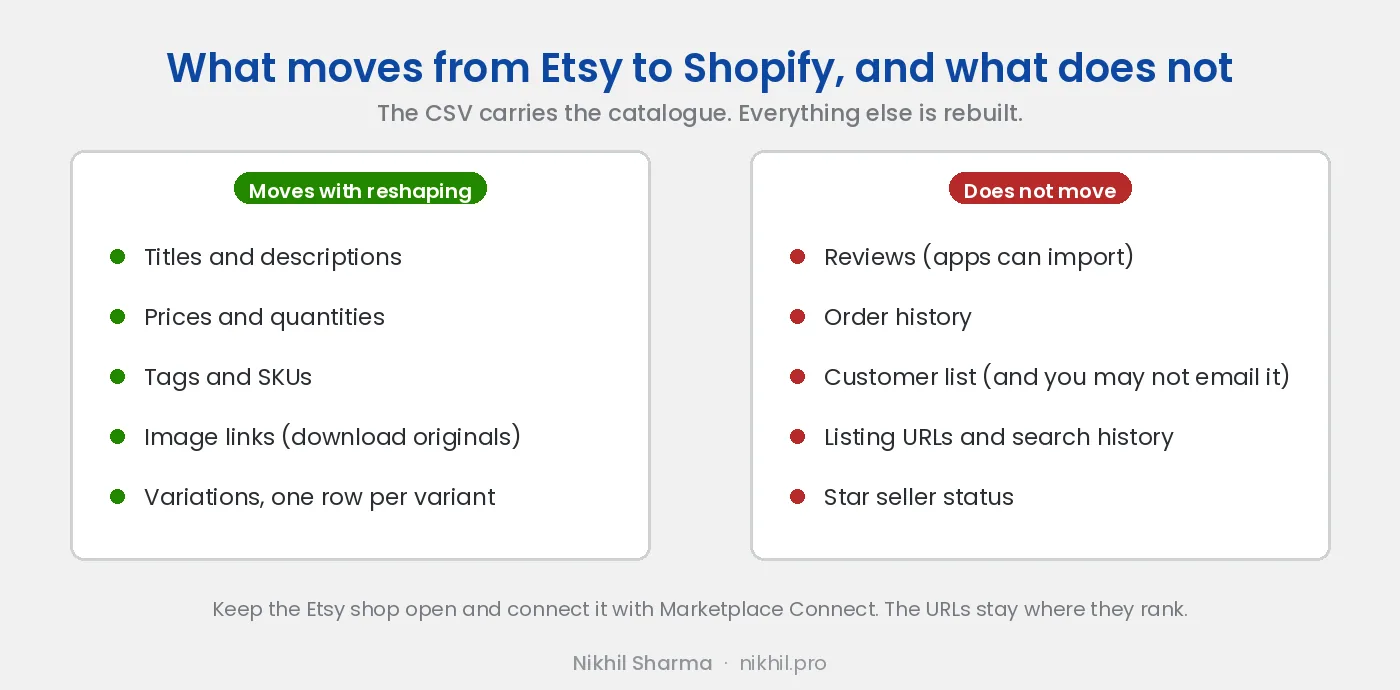
Three things need attention. Etsy puts all the values of a variation in one cell, so a listing with three sizes becomes one row that Shopify will read as one variant unless you split it into three. Etsy image links point at Etsy’s servers and work for the import, but download your originals anyway because those links are not yours. And Etsy descriptions are plain text with line breaks, which Shopify imports into the HTML body as one paragraph unless you add the breaks.
What does not move at all: reviews, order history, the customer list, and the listing URLs. Each has its own section below.
3. Reshape and import
Two routes. Do it in a spreadsheet: rename columns to Shopify’s product CSV headings, generate a handle from each title, expand variations to one row each with the shared handle, and set Published to true. For a shop under a hundred listings this is an afternoon. Or use an import app from the Shopify App Store that reads the Etsy file directly and does the reshaping, which is $20 to $50 one off and worth it above a hundred listings or with heavy variations.
Then Shopify admin, Products, Import, upload, preview, import. Check five products by hand before you trust the rest: a simple one, one with variations, one with ten images, one with a long description, one with a sale price.
4. Reviews
They belong to Etsy and they stay there. Review apps such as Judge.me offer an Etsy import that brings them across from the CSV you downloaded; check Etsy’s terms before republishing them on your own site. Whatever you decide, switch on review collection on Shopify from the first order, because a new store with no reviews is the trust problem covered here.
5. Customers, and the rule that gets shops closed
You cannot take your Etsy buyers’ emails and add them to Klaviyo. Etsy’s policies prohibit using buyer information for unsolicited marketing off the platform, and sellers lose their shops over it. What you can do: tell buyers about your own site in the order message and in the package, link it from your Etsy profile and About section, and invite them to opt in. A card in the box with a reason to sign up works better than the email you are not allowed to send anyway. The Klaviyo list post covers building the list properly from the Shopify checkout.
6. Keep Etsy open and connect it
Install Shopify’s Marketplace Connect app, link the Etsy shop, and let Shopify be the source of truth for products and inventory. Etsy orders flow into Shopify, stock stays in sync, and you stop maintaining two catalogues. The Etsy listings keep their URLs and their search history. The old guides that tell you to close Etsy on launch day are the reason so many migrations are followed by six quiet months.
7. Set up the things Etsy used to do for you
Payments and taxes in Shopify settings. Shipping profiles with the processing times you choose. A returns policy page. Then, before any paid traffic, the tracking: Meta pixel and Conversions API, Google Analytics, Merchant Center with free listings on. Merchant Center matters more than most sellers expect, because Google Shopping free listings are the closest thing to Etsy search that exists outside Etsy.
After the move: the traffic problem
The import is the easy day. The next six months are earning the visitors Etsy used to send. Google free listings first, because they cost nothing. Then the $45 a day test on Meta to find out which product the cold audience responds to. Then email to the list you are building from checkout. The beauty brand case study is a store that made exactly this move, from Etsy to its own store to $50,000, and it documents the order.
If you would rather have the migration done, I keep a short list of Shopify people I refer work to. If you want to talk through whether the move makes sense for your shop first, book a call. The first question I ask is what share of your Etsy orders come from Etsy search rather than from people who already know your name, because that number is how hard the next six months will be.
Frequently asked questions
Should I move from Etsy to Shopify?
Can you import Etsy listings to Shopify?
Do Etsy reviews transfer to Shopify?
Can I email my Etsy customers about my new Shopify store?
What does the Etsy to Shopify migration cost?
Can I keep selling on Etsy from Shopify?
What is the hardest part of moving from Etsy to Shopify?
Get new posts in your inbox
Occasional notes on Shopify, paid ads, and what I learn. No spam.
Thanks. Check your inbox to confirm.

Nikhil Sharma
I run data and operations for a DTC brand on Shopify, consult on Meta and Google Ads, and build AI automations for ecommerce teams. I write about what I build and run.