Facebook Ad Fatigue: How to Spot It and Actually Fix It
Is your Facebook ad performance gradually declining? Are you no longer getting the purchases or leads you once did?
Before you rebuild the whole account, check whether you are just dealing with ad creative fatigue. It is one of the more common causes of a slow decline, and one of the more fixable ones.
What is Facebook Ad Fatigue?
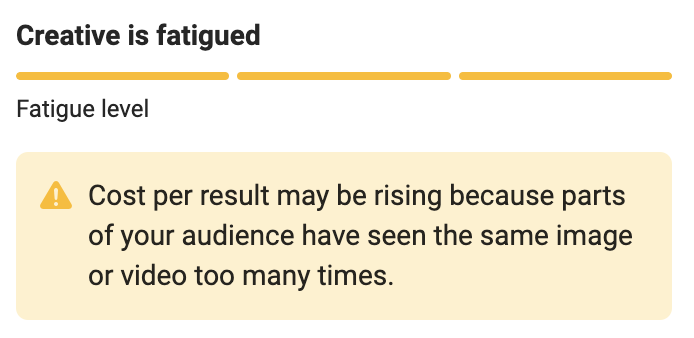
Ad creative fatigue happens when Meta has delivered an ad too many times, the audience has seen it too many times, and people simply stop responding. Performance decays even though nothing about your targeting, offer or landing page changed.
Rising frequency is the tell.
What Causes Ad Fatigue?
Frequency
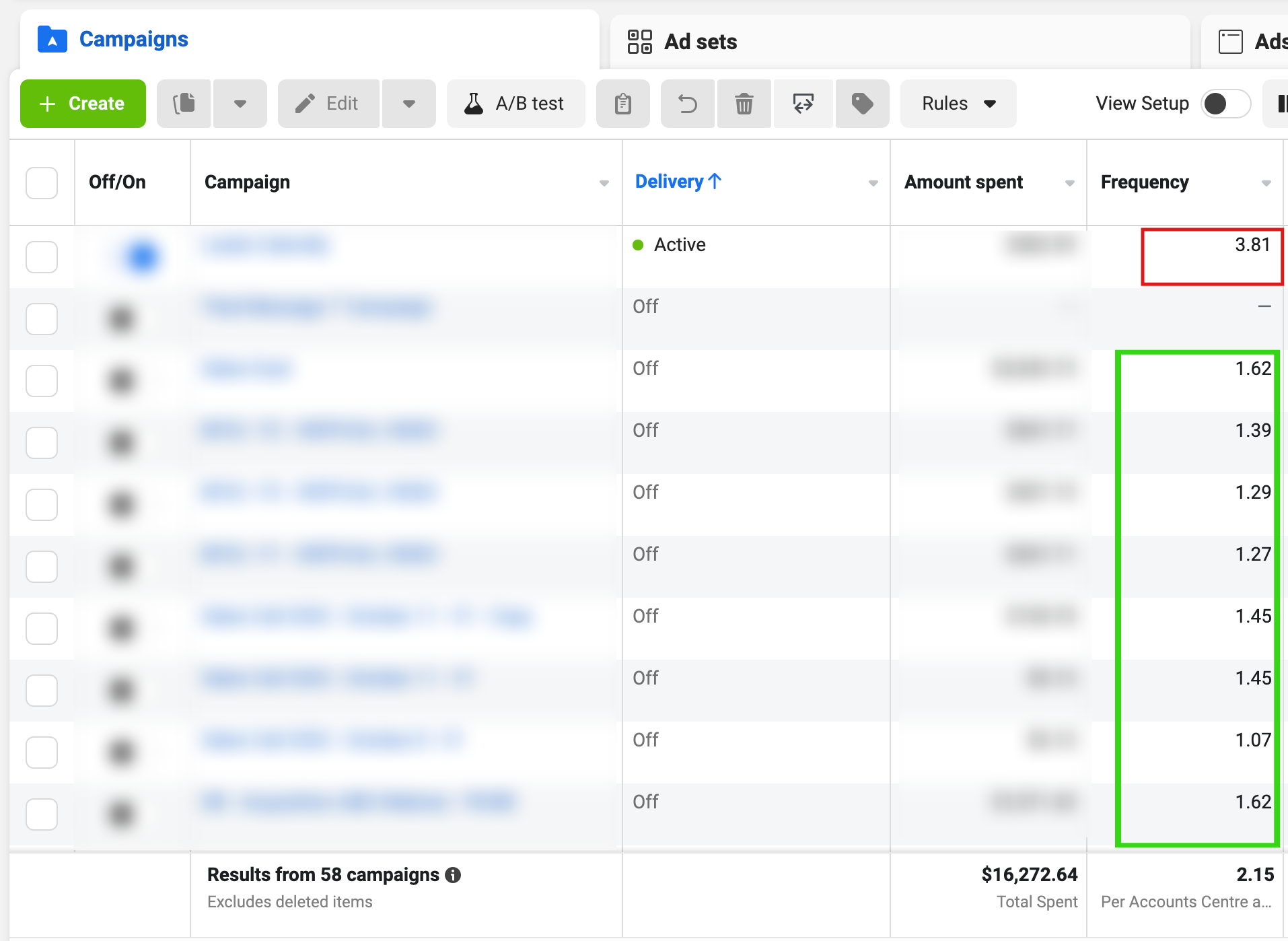
Frequency is calculated from impressions and reach. It tells you the average number of times someone in your target audience has been exposed to your ad over a given period.
Lower is generally better, and between 1.8 and 4 is a reasonable working range for prospecting. Most ads showing creative fatigue will be sitting above that.
Audience Size
Audience fatigue is the other half of it. A genuinely good ad loses momentum fast if the pool it is shown to is too small. In that case it is not the creative that is tired, it is the audience.
This is why very tight retargeting windows burn out quickest. If you are only targeting people who visited in the last day, you may be showing the same ad to a few hundred people repeatedly.
The Newer Cause: Your Ads Are Not As Different As You Think
This one did not exist when I first wrote this post, and it is now one of the most common causes I see.
Meta’s retrieval system groups ads by visual similarity and treats near-identical creatives as a single entity. So when you “refresh” a campaign by swapping the headline over the same footage, the audience is effectively still seeing the same ad. Frequency keeps climbing, and your refresh did nothing.
I’ve written the full mechanism in why Meta only spends on a few of your ads, and the wider context in what Meta Andromeda actually is.
How to Identify Ad Fatigue
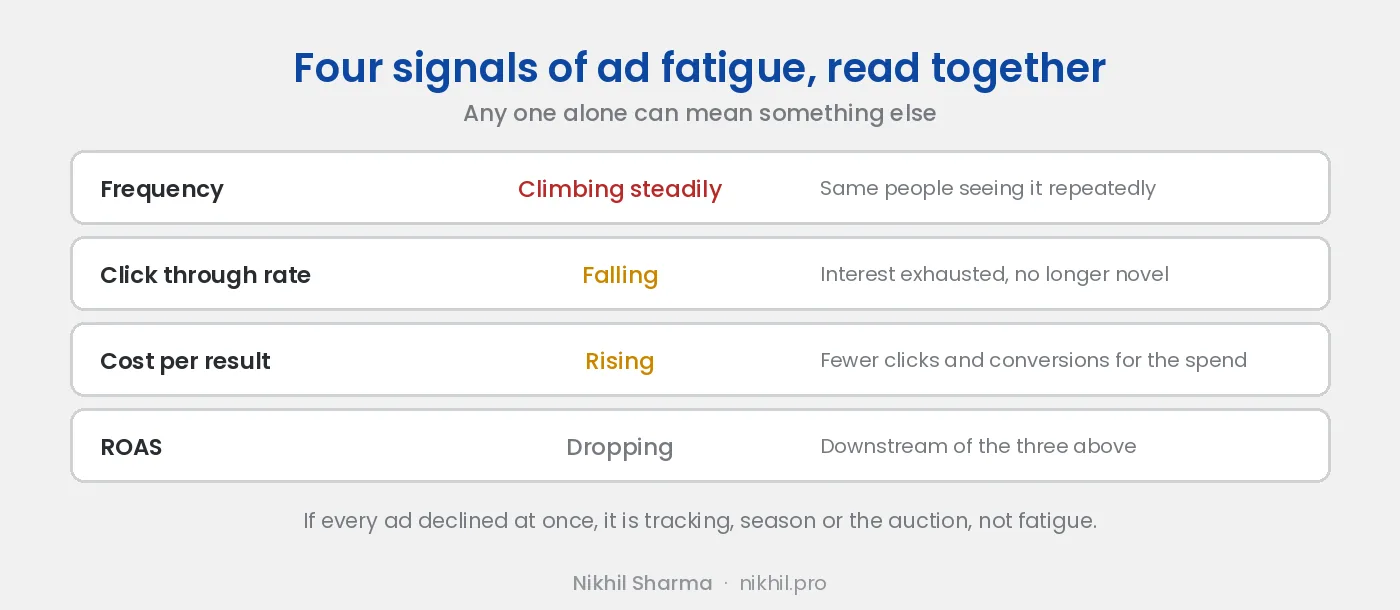
Watch three metrics together. Any one of them alone can mean something else entirely.
Decrease in Click-Through Rate
CTR measures how often people who saw your ad went on to click it. People click when something interests them. See the same thing enough times and it stops being interesting, so CTR slides. That slide is usually the earliest visible signal.
Increasing Cost Per Result
Cost per result tells you how efficiently the campaign converts spend into outcomes. Lower is better. When it climbs while frequency climbs, the ad is losing momentum rather than the market getting more expensive.
Drop in ROAS
ROAS is the downstream consequence. By the time it moves, the other three have usually been signalling for a while. If ROAS drops and frequency is high, fatigue is the immediate suspect.
What Stopped Working
Worth being direct about this, because most articles on ad fatigue still recommend these and they are much weaker than they used to be.
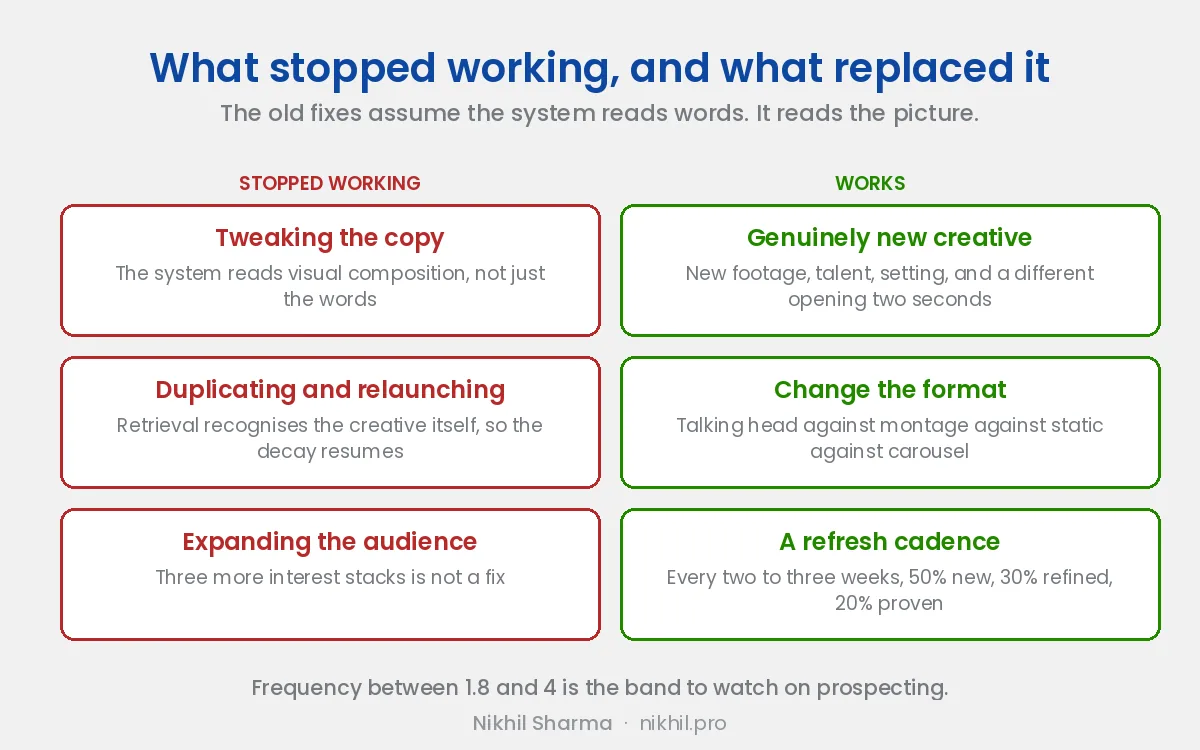
Tweaking the ad copy. Changing the primary text, headline or description over the same visual rarely produces a genuinely new ad in Meta’s eyes. The system reads the visual composition, not just the words. Your audience sees the same image with different text, which is not the reset you wanted.
Duplicating and relaunching. This used to work because a fresh ad ID looked like a fresh start. The retrieval system now recognises the creative itself, so the decay tends to resume where it left off.
Endlessly expanding the audience. Still useful, but far less of a lever than it was. Interest targeting behaves as a soft signal rather than a hard gate now, and Meta is already expanding delivery on its own. Broadening a tight retargeting window is worth doing. Adding three more interest stacks usually is not.
What Actually Fixes Ad Fatigue
1. Add Genuinely New Creative
Add more creatives. Meta does not charge you more for having more of them, and it is the only fix that addresses the actual cause.
The word doing the work there is genuinely. New footage, new format, new opening two seconds, different talent, different setting. If a stranger could not tell your new ad apart from the old one at a glance, the system probably cannot either.
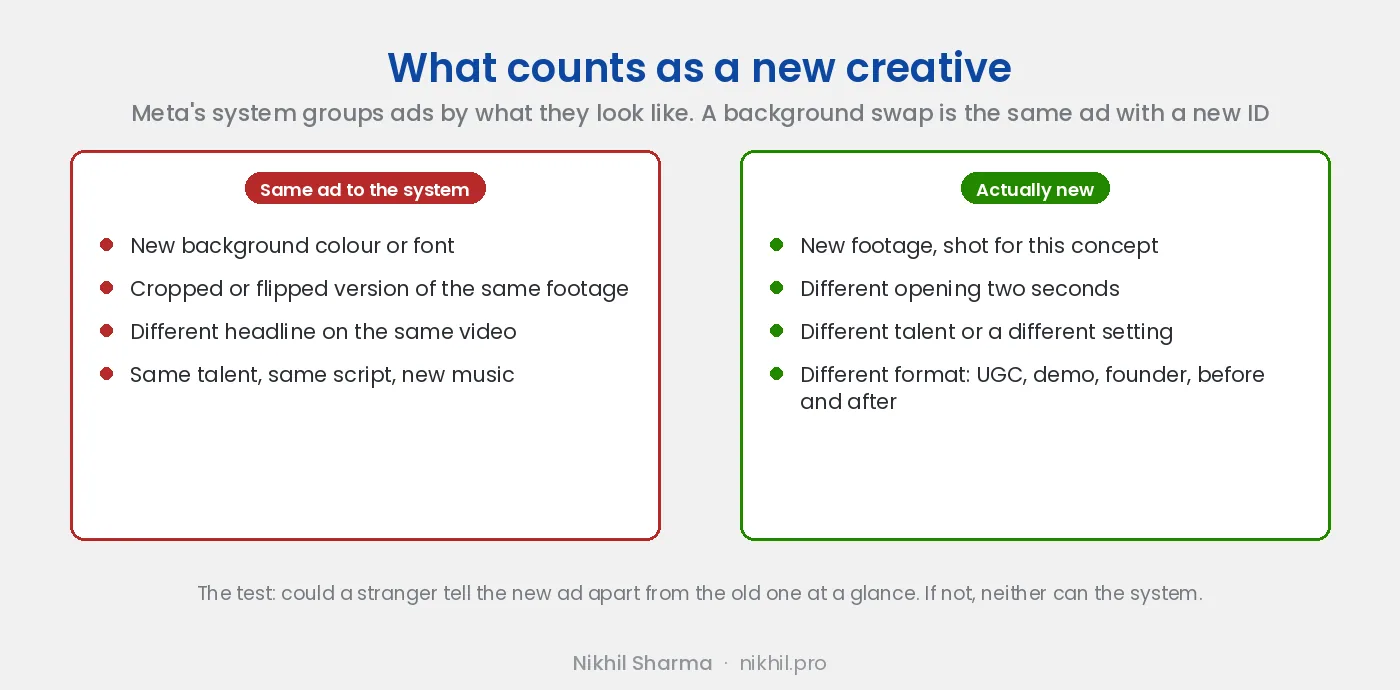
2. Change Format, Not Just Content
Rotating format is one of the cheapest ways to produce real difference. If the fatiguing ad is a talking head, try a montage, a static, a carousel, or a UGC-style clip. Meta’s flexible ad format gives you another way to surface different assets to different people within one ad.
3. Build a Refresh Cadence Instead of Reacting
The most effective fix is not fixing it at all, it is never letting it build up.
Most teams are landing on a two to three week refresh cycle, with roughly 50% new concepts, 30% refined variants of what is working, and 20% proven performers left running.
If producing that volume is the bottleneck, AI-generated UGC is a realistic way to increase output without proportionally increasing cost.
4. Expand the Audience Where It Is Genuinely Too Small
Still worth doing where the pool is the actual problem.
If you are retargeting only yesterday’s visitors, that audience may be a few hundred people. Widen the window. If you are targeting one city, open it to the region. Broad location-only targeting is often a better starting point than layered interests.
The test is whether frequency is high because the pool is small. If your prospecting audience is already in the millions and frequency is still climbing, the audience is not your problem, the creative is.
5. Expand Placements
If you are running Facebook feed only, you are limiting reach for no reason. Instagram, Reels, Stories, Messenger and Audience Network all give the system more places to deliver, which lowers frequency at the same spend.
Pull the placement breakdown report in Ads Manager, sort by frequency, and see where the same people are seeing you repeatedly.
6. Use a Frequency Cap, With Realistic Expectations
A frequency cap limits how often your ad is served to the same person in a given window. Lower the cap for wider reach, raise it for more repetition to fewer people.
The Short Version
Ad fatigue is rising frequency plus falling CTR plus rising cost per result, on specific creatives, while newer ones still perform.
The old fixes lost most of their power. New copy over the same visual does not create a new ad. Duplicating a campaign does not reset the decay. Expanding interests barely moves anything.
What works is genuine creative difference, produced on a schedule rather than in a panic. Rotate format, change the opening two seconds, and run a two to three week refresh cycle so fatigue never gets a chance to build.
If you want the wider picture on why creative became the whole lever, start with what Meta Andromeda actually is. If you’re scaling a Shopify store, the 2026 Meta ads scaling guide covers budget and structure on top of this, and my beauty brand case study is a worked example of the whole thing running together.
Grow Your Brand with Nikhil Sharma
I run data and operations engineering for a DTC brand and help other brands with Meta and Google Ads, email, and the systems underneath them. Schedule a call if you want a second pair of eyes on your account.
Frequently asked questions
What is Facebook ad fatigue?
What is a good ad frequency on Facebook?
How do I know if it is ad fatigue or something else?
Does changing the ad copy fix ad fatigue?
Does duplicating a campaign reset ad fatigue?
How often should I refresh creative to avoid fatigue?
Can I use a frequency cap to fix ad fatigue?
Get new posts in your inbox
Occasional notes on Shopify, paid ads, and what I learn. No spam.
Thanks. Check your inbox to confirm.

Nikhil Sharma
I run data and operations for a DTC brand on Shopify, consult on Meta and Google Ads, and build AI automations for ecommerce teams. I write about what I build and run.